







In This Article
- The erosion of personal ownership
- Physical barriers to repairs
- The digital gatekeepers of hardware
- Impacts on the local repair economy
- The reality of corporate justifications
- Reclaiming the freedom to fix
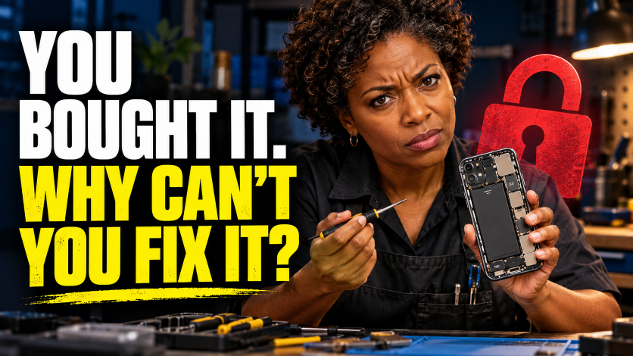
You bought the phone. The battery is wearing out, but the rest of it still works. You would like to replace the battery and keep using what you paid for. A reasonable request, surely. Then you discover what it takes to get the thing open, find the part, and finish the repair. The manufacturer has made plenty of decisions about your phone. Apparently, deciding who may fix it was one of them.
The appliance is yours until you need to fix it. Then somebody at the company gets to decide whether you can have the part or the instructions. Funny, they didn’t need permission to take your money.
You Bought It. Who Controls the Repairs?
There are good reasons to hire someone who knows how to repair a device. Few of us want to spend a weekend learning how to dismantle a washing machine. But choosing a repair service is different from having the choice made for you.
Suppose you prefer the independent shop down the road. Its technician may know exactly what has failed and how to replace it. That knowledge does little good if the manufacturer withholds the replacement part or the information needed to install it.
Now your decision depends on what the company will allow. You can use its approved service, accept its price, or consider buying another machine. Some choice.
I have no objection to a manufacturer offering repairs. I object to its standing between the owner and everyone else who could do the job.
First, Try Getting It Open
You can take out a screw and put it back when you’re done. But if the battery is glued in beneath the screen, you have to work your way through both. All this to replace a battery. Break the screen getting there, and you’ll need to buy that too.
The FTC’s 2021 report, Nixing the Fix, examined adhesives that make repairs difficult, along with restrictions on parts, tools, and diagnostic software. So this complaint has made it past the repair counter and into a report to Congress.

The sealed case looked fine when you bought it. Now someone has to get inside, and you will be paying for the time that takes. Crack the screen along the way, and the battery is no longer your only problem.
We should ask manufacturers how those design decisions affect maintenance. They know batteries wear out. They know screens break. A product ought to be designed with some allowance for what happens after the advertisement has done its job.
The Screwdriver Cannot Supply the Password
You get the case open and fit the replacement part. Some equipment then requires diagnostic software or a manufacturer’s procedure before it will recognize what you installed. Can you get access? If not, you may have to take the thing to an authorized shop after doing the physical repair yourself.
Imagine paying a technician who can identify the fault but cannot obtain the software needed to complete the work. The technician has the skill. The manufacturer has the permission slip.
Restricted diagnostic access was among the barriers examined by the FTC. This deserves attention because it is easy to overlook when buying a product. We can inspect the screen, try the buttons, and compare prices. Discovering who controls the repair software usually comes considerably later.
By then, the company already has our money.
What Is the Local Shop Supposed to Do?
An independent repair business needs parts, tools, and information. Deny it those, and even a capable technician has to turn work away.
That leaves the customer with fewer places to go. It also gives the manufacturer’s service operation an advantage that has little to do with whether its technicians are better.
We hear plenty about supporting small businesses. Here is an opportunity to mean it. Let the repair shop obtain what it needs to compete, and let customers decide whether its work and prices suit them.
The shop should have to earn our business. So should the manufacturer. Owning the instructions ought not to settle the competition before either has picked up a tool.
And when replacement becomes easier than repair, we have another bill to consider. Making electronics takes materials and energy. Throwing away an otherwise useful device because one part has failed wastes more than the owner’s money. We paid to manufacture the rest of it too.
Safety Deserves an Answer
A battery can catch fire if you damage it during a repair. I would want the technician to know what they were doing. I would also want my private data left alone. If the independent shop can do the job safely and protect that data, why should I have to take it somewhere else?
But saying “safety” does not finish the discussion.
The FTC found little evidence supporting manufacturers’ justifications for the restrictions it examined. That finding does not make every repair safe for an amateur. It does give us reason to question a sweeping claim that authorized service is the only acceptable answer.
What is the hazard? What training or equipment addresses it? Could an independent technician meet the same requirements?
If the concern is a dangerous procedure, explain the procedure. If it is protecting data, explain the protection. Give owners and repair businesses something they can act on.
A company that benefits financially from limiting repairs should expect questions about those limits. It should be able to answer without treating the customer as a nuisance.
Let Us Keep What Still Works
Right to repair starts with a fairly ordinary wish: keep using something after a part wears out.
An owner may want to do the work personally or pay someone else. Either way, access to replacement parts, service information, suitable tools, and necessary software can determine whether the repair happens at all.
Manufacturers could start by selling us the parts and letting us read the service manual. Before buying, ask whether the repair shop you use can get either. And lawmakers ought to ask why a company gets to collect the purchase price and then decide who may repair what it sold.
None of that requires pretending every appliance will last forever. Things wear out. Some repairs cost more than they are worth. We ought to be able to reach that decision after getting a fair opportunity to fix the thing.
Before agreeing to buy another machine, ask why this one cannot be fixed. Is it worn out, or can nobody get the part? I would like an answer to that before handing the same company more money.
About the Author
 Robert Jennings is the co-publisher of InnerSelf.com, a platform dedicated to empowering individuals and fostering a more connected, equitable world. A veteran of the U.S. Marine Corps and the U.S. Army, Robert draws on diverse life experience, from real estate and construction to building InnerSelf.com with his wife, Marie T. Russell, bringing a practical, grounded perspective to life's challenges. InnerSelf grew from InnerSelf Magazine, founded by Marie T. Russell in 1985, which became InnerSelf.com in 1996. Decades later, InnerSelf continues to inspire clarity and empowerment.
This article is licensed under a Creative Commons Attribution-NonCommercial-NoDerivatives 4.0 License. You may share it with attribution to Robert Jennings, InnerSelf.com, and a link back to the original article at InnerSelf.com. Commercial use and derivative works are not permitted without permission.
Further Reading
-
Repair Revolution: How Fixers Are Transforming Our Throwaway Culture
John Wackman and Elizabeth Knight explore community repair projects where people share tools and skills to keep useful belongings out of the trash. They show how repairing ordinary household items can save money, reduce waste, and strengthen local connections.
Amazon: https://www.amazon.com/exec/obidos/ASIN/1608686604/innerselfcom
-
Shop Class as Soulcraft: An Inquiry into the Value of Work
Matthew B. Crawford examines the judgment and satisfaction involved in skilled manual work, drawing on his experience repairing motorcycles. His account gives practical competence its due and asks what we lose when we become dependent on things we cannot understand or maintain.
Amazon: https://www.amazon.com/exec/obidos/ASIN/0143117467/innerselfcom
-
Secondhand: Travels in the New Global Garage Sale
Adam Minter follows used possessions through the businesses that collect, repair, and resell them. He examines why some products find another useful life while others become waste, showing how durability and repairability affect what happens after the first owner lets them go.
Amazon: https://www.amazon.com/exec/obidos/ASIN/1635570107/innerselfcom
Article Recap
The right to repair is a critical issue regarding personal ownership and the sustainability of our consumer habits. By removing barriers like proprietary software and restricted parts, we can empower consumers and support local repair businesses while reducing waste.
#RightToRepair #ConsumerRights #Sustainability #Ownership #TechNews #FairTrade #ConsumerAdvocacy #RepairEconomy #Smartphones #SustainableLiving