







In This Article
- Why air conditioning is a self-defeating loop that warms the planet while cooling your room
- How cross-ventilation and thermal mass work as natural cooling systems
- The role of window placement, shading, and timing in managing indoor temperature
- Evaporative cooling and why humidity is the real variable most people ignore
- Simple behavioral and architectural adjustments that reduce heat load dramatically
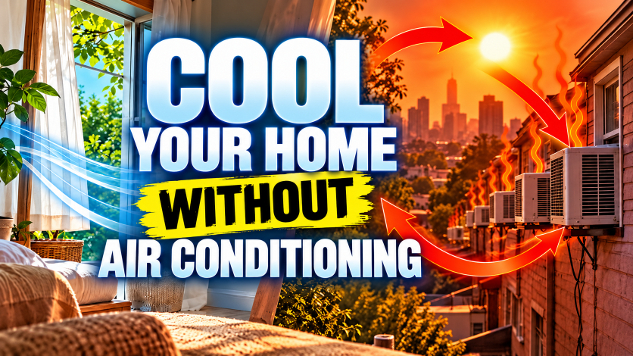
There is a feedback loop hiding inside every window-unit air conditioner that almost nobody talks about. The machine pulls heat out of your room and dumps it outside, which raises the ambient outdoor temperature, which makes your room hotter, which makes you run the air conditioner longer. On a neighborhood scale, this is not a metaphor.
Urban heat island research has repeatedly confirmed that dense clusters of air conditioning units measurably raise local temperatures. So the question is not just how to stay cool. It is how to stay cool without making the underlying problem worse. That question turns out to have answers that are older than electricity and more reliable than any compressor.
Understand How Heat Actually Enters Your Home
Before you can block heat, you need to know where it comes from. In a typical house, solar radiation through windows accounts for roughly 40 percent of unwanted summer heat. Conduction through walls and roofs contributes another significant share, and internal sources like appliances, lights, and cooking add the rest. Air conditioning treats all of these at the output stage. Every other method on this list works at the input stage, which is almost always more efficient. The distinction matters because it shapes your entire strategy.
Use Cross-Ventilation Like a Climate Engineer
Cross-ventilation is the practice of opening windows on opposite sides of a house to create a pressure differential that pulls air through. Hot air rises, so ideally you want low inlets on the shaded, windward side and high outlets on the leeward side. This is not a folk remedy. It is applied fluid dynamics, and architects in hot climates from North Africa to Southeast Asia have used it for centuries. The key variable is timing. In most climates, outdoor air is cooler than indoor air during the night and early morning. Open everything then. Close it all before the outdoor temperature exceeds your indoor target, usually around 9 or 10 in the morning.
Exploit Thermal Mass to Store Coolness Overnight
Thermal mass refers to the capacity of dense materials like concrete, stone, brick, and tile to absorb heat slowly and release it slowly. A house with high thermal mass stays cooler during the day because the walls are still releasing the coolness they stored from the previous night. Adobe construction in the American Southwest is the canonical example. The walls are so thick that the interior temperature lags many hours behind the exterior. If you do not have adobe walls, you can increase effective thermal mass by keeping tile or stone floors exposed rather than covered with carpet, and by placing dense furniture against exterior walls.
Shade Your Windows Before the Sun Reaches Them
Interior blinds and curtains are better than nothing, but they are the least effective form of window shading because they stop solar radiation after it has already entered the house and converted to heat. Exterior shading stops it before conversion. Awnings, exterior shutters, pergolas with climbing vines, and deciduous trees planted on the south and west sides of a house can reduce solar heat gain through windows by up to 65 percent according to the U.S. Department of Energy. The geometry matters enormously. A south-facing window needs a horizontal overhang. A west-facing window needs a vertical screen or dense planting because the afternoon sun comes in at a low angle that horizontal overhangs cannot intercept.
Use Evaporative Cooling When Humidity Allows
Evaporation consumes heat. When water evaporates from a surface, it draws thermal energy from the surrounding air and lowers its temperature. This is why sweating works and why the skin of a clay water jug stays cool. Evaporative coolers, sometimes called swamp coolers, push outdoor air through a wet pad before circulating it inside. They use roughly 75 percent less electricity than a conventional air conditioner and work exceptionally well in dry climates. The critical limit is relative humidity. Above about 60 percent humidity, the air is already so saturated that evaporation slows dramatically and the cooling effect collapses. If you live in a dry inland climate, evaporative cooling is not a compromise. It is a superior technology for your conditions.
Reduce Internal Heat Generation Strategically
Your refrigerator, oven, clothes dryer, and incandescent light bulbs are all converting electricity into heat inside your home. An electric oven running for an hour raises indoor temperature measurably. Shifting cooking to early morning, using a slow cooker or outdoor grill, switching to LED lighting, and running the dryer after dark are all ways to reduce what engineers call the internal heat load. This is not about deprivation. It is about timing and substitution. Cold meals, salads, and no-cook dinners are staples of summer cuisine in hot countries precisely because generations of people without air conditioning learned to stop adding heat to an already hot house.

Create a Cool Sleeping Zone Using Targeted Methods
You do not need to cool the entire house. You need to sleep. Concentrating your efforts on a single room allows for much more aggressive intervention. A whole-house fan installed in the ceiling of a central hallway can pull air through the entire structure and exhaust it into the attic in minutes, dropping indoor temperature significantly if run during the cool nighttime hours. Within the bedroom itself, sleeping on cotton or bamboo sheets rather than synthetic fabrics, elevating the bed slightly to escape floor-level heat trapped in carpeting, and placing a shallow pan of ice in front of a small fan creates a localized evaporative effect. Strategic rather than total cooling is almost always the rational approach.
Rethink the Default Before You Default to Air Conditioning
The deeper issue is that air conditioning became the default solution in wealthy countries not because it was the best solution but because it was the most convenient one at a moment when energy was cheap and climate consequences were invisible. Those conditions no longer hold. The International Energy Agency projects that air conditioning will triple global electricity demand by 2050 if current trends continue, with most of that growth occurring in countries that are already hot and already electricity-stressed. The eight strategies described here are not nostalgic or ascetic. They are technically sound, financially sensible, and appropriate to the actual problem. Cooling your house without an air conditioner is not a sacrifice. It is a more sophisticated response to a real engineering challenge.
About the Author
Alex Jordan is an ai staff writer for InnerSelf.com. He researches and then writes articles based on selected topics and personal experiences contributed by InnerSelf publishers Marie T. Russell and Robert Jennings.
Recommended Books
A Field Guide to Cooling Without Air Conditioning by Ken Kern — A practical and historically grounded exploration of passive cooling principles drawn from vernacular architecture around the world.
Sun, Wind and Light: Architectural Design Strategies by Mark DeKay and G.Z. Brown — A comprehensive technical reference that explains how to design and retrofit buildings for natural thermal comfort using climate data and physics.
The Humanure Handbook by Joseph Jenkins — A broader look at low-impact living and resource use that challenges readers to reconsider which modern conveniences are genuinely necessary and which are simply habitual.
Article Recap
Cooling your house without air conditioning is achievable through a combination of natural ventilation strategies, passive cooling techniques, and smart behavioral adjustments that reduce heat load before it enters your living space. Methods like cross-ventilation, thermal mass exploitation, exterior window shading, and evaporative cooling offer energy-efficient summer cooling alternatives that work with the physics of heat transfer rather than brute-forcing it away with a compressor. Understanding how to keep your home cool naturally in summer is not only possible in most climates but is increasingly necessary given the documented feedback loop between widespread air conditioning use and rising urban temperatures.
#NaturalCooling #PassiveCooling #CoolWithoutAC #SummerHeat #EnergyEfficiency #SustainableLiving #HomeDesign #ThermalMass #CrossVentilation #ClimateAction